hearingHow We Hear
Anatomy of the ear, hearing mechanics, types & severity levels of hearing loss, and verified educational resources.
Hearing involves a complex sequence of mechanical and electrical conversions across the outer, middle, and inner ear to transform acoustic vibrations into brain perception.
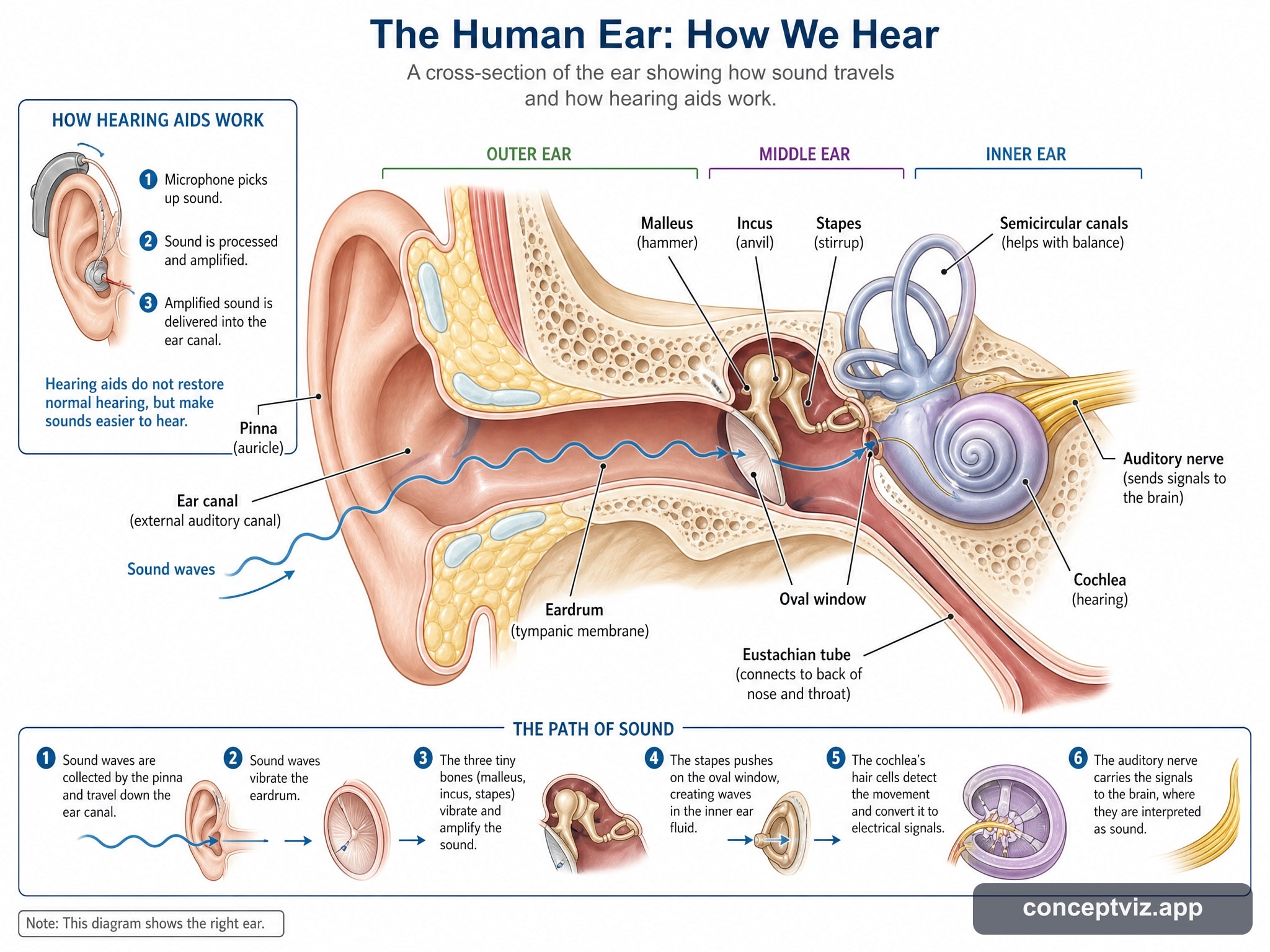
- 1Outer Ear (Pinna & Ear Canal):
Sound waves travel through the air and are funnelled by the pinna down the ear canal to strike the eardrum (tympanic membrane).
- 2Middle Ear (Eardrum & Ossicles):
The eardrum vibrates, moving three tiny bones (the malleus, incus, and stapes) which amplify the vibrations into the inner ear.
- 3Inner Ear (Cochlea & Hair Cells):
Vibrations ripple fluid inside the snail-shaped cochlea, bending thousands of microscopic hair cells (stereocilia) that generate electrical signals.
- 4Auditory Nerve to Brain:
The auditory nerve carries electrical signals to the auditory cortex in the brain, where they are interpreted as speech, music, or environmental sounds.
Explore verified 3D medical animations and comprehensive guides explaining the biology of hearing:
Main Types of Hearing Loss:
Caused by damage to delicate cochlear hair cells inside the inner ear or the auditory nerve. This is the most common form of hearing loss, often age-related (presbyacusis) or noise-induced. While permanent, it is effectively managed and treated with modern digital NHS hearing aids and cochlear implants.
Occurs when sound vibrations cannot pass efficiently through the outer ear canal, eardrum, or middle ear ossicles (e.g. earwax compaction, middle ear fluid/glue ear, eardrum perforation, or otosclerosis). Conductive hearing loss is frequently treatable medically or surgically.
A combination of both sensorineural and conductive hearing loss in the same ear (for example, age-related sensorineural loss with temporary conductive fluid or earwax blockage).

Audiological Severity Levels (Decibel Hearing Level - dB HL):
- Mild (21 – 40 dB HL): Soft speech or quiet whispers missed; listening fatigue in background noise.
- Moderate (41 – 70 dB HL): Speech difficult to follow without facing the speaker or using hearing aids.
- Severe (71 – 90 dB HL): Rely heavily on lip-reading, captions, or high-power hearing aids; loud speech required.
- Profound (91+ dB HL): Most sounds unheard; reliance on British Sign Language (BSL), captions, or Cochlear Implants.
Hearing loss can stem from genetic factors, ear infections, acoustic trauma, or underlying medical conditions:
- Meniere's Disease (Fluid pressure)
- Tinnitus (Ringing/buzzing)
- Hyperacusis (Sound sensitivity)
- BPPV (Inner ear balance crystals)
- Otosclerosis (Bone stiffness)
- Eustachian Tube Dysfunction
- Otitis Media / Externa (Infections)
- Tympanic Perforation